
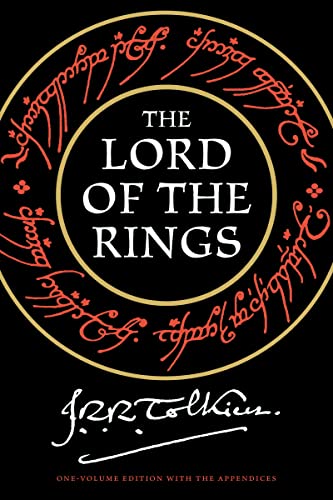
The Lord Of The Rings: One Volume
- 4.9 out of 5
- 14,662 ratings
- 1,206 pages

Overall Content Rating: Parents Strongly Cautioned PG-13
This is a long epic fantasy about a quest to destroy a powerful evil artifact. The tone is heroic and often warm, with friendship, loyalty, and moral choices at the center. Customer feedback from young readers and families commonly describes the language as free of modern swearing, with no sexual content on the page; romance appears as deep love and commitment rather than physical intimacy. Parents should expect sustained fantasy violence tied to war and adventure, plus thematic material some reviewers flag as reflecting older racial and social assumptions. Scary or intense moments include dark enemies, pursuit, and monstrous threats, though the book is widely read aloud to children with selective discussion or editing of the darkest passages.
Reviews first uploaded October 6, 2026 7:37 pm. Page updated October 6, 2026 7:37 pm.
These summaries are AI-generated from relevant Amazon reviews of this book.
Crude
21Specific words
- stupid: 8
- faggot: 6
- suck: 4
- idiot: 2
- fag: 1
LGBTQ+
55Specific words
- queer: 55
Profanity
9Specific words
- ass: 3
- butt: 2
- hell: 2
- bastard: 1
- damn: 1
Sex
44Specific words
- grope: 32
- cock: 10
- boner: 1
- rape: 1
Violence Moderate
115Physical conflict runs through much of the story, including large battles, skirmishes, and weapons use. Characters face danger from enemies, monsters, and pursuit; injuries and deaths occur in wartime and adventure scenes. A later stretch after the main quest brings more fighting and intimidation when the hobbits return to their homeland. The writing focuses on courage, sacrifice, and consequences rather than prolonged graphic description of harm.
Amazon reviews mentioning violence
Specific words
- blood: 60
- stab: 30
- kick: 15
- gore: 4
- bleed: 2
- punch: 2
- smash: 2
Racism Mild
Some readers describe dated or uncomfortable attitudes in how certain peoples and lineages are treated, including broad negative portrayals of groups aligned with the enemy and strong emphasis on bloodline and kinds of beings. This appears as worldbuilding and description rather than as a central modern-style hate plot, but it may still trouble families sensitive to stereotyping or exclusion.
About this book
One Ring to rule them all, One Ring to find them, One Ring to bring them all and in the darkness bind them In ancient times the Rings of Power were crafted by the Elven-smiths, and Sauron, the Dark Lord, forged the One Ring, filling it with his own power so that he could rule all others. But the One Ring was taken from him, and though he sought it throughout Middle-earth, it remained lost to him. After many ages it fell by chance into the hands of the hobbit Bilbo Baggins. From Sauron's fastness in the Dark Tower of Mordor, his power spread far and wide. Sauron gathered all the Great Rings to him, but always he searched for the One Ring that would complete his dominion. When Bilbo reached his eleventy-first birthday he disappeared, bequeathing to his young cousin Frodo the Ruling Ring and a perilous quest: to journey across Middle-earth, deep into the shadow of the Dark Lord, and destroy the Ring by casting it into the Cracks of Doom. The Lord of the Rings tells of the great quest undertaken by Frodo and the Fellowship of the Ring: Gandalf the Wizard; the hobbits Merry, Pippin, and Sam; Gimli the Dwarf; Legolas the Elf; Boromir of Gondor; and a tall, mysterious stranger called Strider. This new edition includes the fiftieth-anniversary fully corrected text setting and, for the first time, an extensive new index. J.R.R. Tolkien (1892-1973), beloved throughout the world as the creator of The Hobbit, The Lord of the Rings, and The Silmarillion, was a professor of Anglo-Saxon at Oxford, a fellow of Pembroke College, and a fellow of Merton College until his retirement in 1959. His chief interest was the linguistic aspects of the early English written tradition, but while he studied classic works of the past, he was creating a set of his own. Read more